Search “tactical seat covers” and you will find two very different products: genuine tactical covers built to military specifications with real MOLLE webbing, and camo-print seat covers that use the word “tactical” as a marketing label. This guide cuts through the noise. We explain what actually makes a cover tactical, walk through the materials and specifications that matter, and give you our honest ranked picks — with Bartact’s USA-made MOLLE covers at the top where they belong.
📌 Bottom line up front: Bartact makes the best tactical seat covers on the market. American-made, real mil-spec MOLLE, Cordura nylon construction, Berry Amendment compliant. Every other pick on this page is a runner-up by a significant margin.
What Actually Makes a Seat Cover “Tactical”?
The word “tactical” is one of the most overused labels in the consumer market. You will find $25 universal covers on Amazon called “tactical” because they are black or have a camo pattern. Here is what separates genuine tactical seat covers from marketing fiction:
1. Real MOLLE Webbing — Not Decoration
MOLLE stands for Modular Lightweight Load-carrying Equipment — the military gear attachment standard used on plate carriers, vests, packs, and now seat covers. True MOLLE uses horizontal rows of 1-inch nylon webbing, spaced 1 inch apart, allowing any standard MOLLE-compatible pouch to attach via a weave-through strap system. Once attached correctly, a MOLLE pouch will not shift even on rough terrain.
MOLLE on a seat cover transforms the seat back into functional, organized real estate. Water bottles, first aid kits, radios, tablets, trail maps — all can be mounted where you can actually reach them quickly without digging through a bag. Fake “MOLLE-style” covers use decorative webbing that is not spaced to spec and will not accept standard military pouches. Real MOLLE costs significantly more to produce and requires precise construction — it is easy to identify once you know what to look for.
2. Mil-Spec Fabric — Cordura vs. Polyester
Genuine tactical seat covers use one of these fabric standards:
- Cordura 500D or 1000D nylon: DuPont’s high-tenacity nylon fabric, originally developed for military load-bearing equipment. Highly abrasion-resistant, UV-stable, and does not absorb water the way woven polyester does. The higher the denier (D), the thicker and more abrasion-resistant the weave. 1000D Cordura is the same material used on serious military plate carrier panels.
- 400D Nylon: Lighter than 1000D but still significantly tougher than consumer polyester. Used where weight and flexibility matter more than maximum durability — commonly seen on headrest covers and areas that need to conform to complex shapes.
- Quality Neoprene (3mm+): Waterproof, flexible, and UV-stable. Not technically “mil-spec” but widely used in quality tactical covers designed for marine and wet-environment applications.
Cheap polyester — the material in most budget seat covers — pills, stretches, and fades within 12 to 24 months of hard use. Mil-spec Cordura routinely lasts a decade under daily abuse. The material difference alone justifies the price gap between a $40 universal cover and a $249 Bartact.
3. Vehicle-Specific Patterning vs. Universal Fit
Military equipment is built to fit a specific platform, not “most vehicles.” Custom-patterned seat covers wrap precisely around headrests, armrests, lumbar supports, and seat bolsters without bunching or slipping. They do not interfere with seat adjustment controls or integrated storage pockets. For Jeeps with side-curtain airbag systems, custom covers are cut with precision seam placement to allow proper airbag deployment. Universal-fit covers cannot achieve any of this.
The difference is most visible in the seat-back area — a universal cover creates folds and pockets of slack material that look sloppy and wear unevenly. A vehicle-specific cover looks like it came from the factory.
4. Heavy-Gauge Stitching and Reinforced Hardware
Tactical covers use high-tenacity thread with consistent stitch counts, not the economy single-pass stitching found on consumer covers. Bar-tack reinforcement at stress points — particularly where MOLLE straps attach and where the cover anchors under the seat frame — is essential for longevity under load. Metal or reinforced plastic buckles replace the friction clips that pop open on the first hard bump. These construction details sound minor until a mounted MOLLE pouch tears free on the trail because the stitching failed.
5. Berry Amendment Compliance — Made in USA
The Berry Amendment (10 U.S.C. 2533a) requires the Department of Defense to procure domestic-manufactured products from American components. Manufacturers who build Berry-compliant gear operate under a different quality standard than overseas contract factories. For seat covers, Berry compliance means American fabric, American stitching, and American assembly from start to finish. Bartact is Berry Amendment compliant. Most competitors — even those marketed as premium tactical brands — are not.
Top Tactical Seat Covers: Ranked & Reviewed
Amazon links include our affiliate tag (brazenprodu01-20) at no additional cost to you. Bartact links go directly to the manufacturer — we receive no affiliate commission on Bartact sales. We recommend them because they are genuinely the best product in this category.

Bartact Tactical Seat Covers — USA-Made, Mil-Spec MOLLE, Cordura Nylon
This is the benchmark against which every other tactical seat cover is measured. Bartact builds vehicle-specific covers for Jeep Wrangler (JK, JKU, JL, JLU, 4XE), Gladiator, Toyota Tacoma, and other off-road platforms using 400D or 1000D mil-spec Cordura nylon, actual MOLLE webbing spaced to military standards, and heavy-gauge stitching throughout. Assembled in the USA. Berry Amendment compliant. More color and pattern options than any competitor.
The MOLLE panel on each seat back accepts any standard military pouch. Covers install without removing the seat and are precision-cut to allow factory airbag deployment. Color options include all-black, coyote tan, OD green, MultiCam, and custom two-tone combinations. Headrest, seat-back, and lower cushion covers are sold as complete integrated sets.
Shop Bartact Seat Covers →💡 Pro tip: Bartact also makes MOLLE-compatible grab handles and door storage bags designed to integrate with their seat covers for a complete, coordinated tactical Jeep interior.
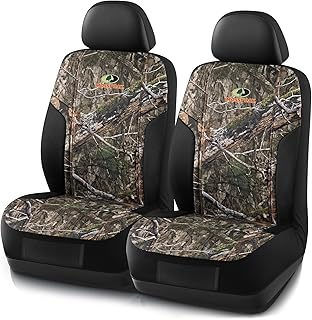
Mossy Oak Camo Seat Covers — Universal Fit, Airbag Compatible
For Jeep owners who want the camo aesthetic on a budget, Mossy Oak’s covers deliver practical seat protection at an accessible price. Built from heavy-duty polyester with reinforced stitching, they handle dirt, moisture, and everyday UV exposure reasonably well. Airbag-compatible design and tool-free installation — you can have them installed in under 20 minutes.
No MOLLE. No custom patterning. No mil-spec materials. But if basic seat protection with a tactical camo look is the goal, these get the job done without a major investment. Think of them as an interim cover while budgeting for Bartact.
View on Amazon →
BDK Hunter Camo Seat Covers — Full Interior Kit
BDK bundles front bucket covers, rear bench covers, headrest covers, and a camo steering wheel cover into one package — a complete interior camo kit at a single price. Airbag-compatible and fits most Jeep Wrangler configurations. If you want a fully coordinated camo interior look on a tight budget, this is the most complete kit at the price point.
View on Amazon →
Mossy Oak LPI Heavy Duty Seat Covers — Full-Size Trucks & SUVs
Designed for full-size trucks and SUVs rather than compact Jeeps, the Mossy Oak LPI uses heavier fabric construction than their standard line plus padded backing to reduce road noise and seat wear-through. If you are running a Gladiator pickup bed configuration or a full-size truck alongside your Wrangler, this is the appropriate Mossy Oak tier.
View on Amazon →Quick Comparison: Real Tactical vs. Budget Camo Covers
| Feature | Bartact (Tactical) | Amazon Budget |
|---|---|---|
| MOLLE webbing (mil-spec) | ✓ Full mil-spec rows | ✗ None or decorative |
| Fabric | ✓ Cordura 400D/1000D nylon | ✗ Consumer polyester |
| Fit type | ✓ Vehicle-specific pattern | ✗ Universal fit |
| Airbag engineering | ✓ Precision seam placement | ✗ Generic claim only |
| Made in USA | ✓ Berry Amendment compliant | ✗ Overseas manufactured |
| Expected lifespan | ✓ 5–10 years hard use | ✗ 1–2 years typical |
| Starting price | ~$249 | ~$40–90 |
Tactical Seat Covers for Jeep Wrangler: Generation-by-Generation Guide
The Jeep Wrangler is the dominant platform for tactical seat covers because Wrangler owners genuinely use their vehicles off-road, haul gear, and prioritize functional interior organization. Here is what is specific to each generation:
YJ (1987–1995)
The original Wrangler YJ used simpler seat designs with less complex bolstering. Aftermarket seat cover options for YJ are more limited than newer generations, but the seats are also easier to wrap. If you are running an older YJ, Bartact can advise on compatible options for your specific configuration. Many YJ owners running upgraded aftermarket seats will find Bartact’s pattern library covers their replacement seats directly.
TJ (1997–2006)
The TJ generation introduced round headlights and a more refined interior compared to the YJ. TJ seats have a distinct shape requiring TJ-specific patterning. Cover options designed for JK or JL seats will not fit a TJ correctly. Contact Bartact directly about TJ fitment as their catalog continues to expand.
JK / JKU (2007–2018)
The JK was Jeep's breakout generation and the first to see serious aftermarket seat cover development at scale. Seat architecture is relatively simple compared to the JL — less complex bolstering, fewer integrated controls, and an older airbag system. Bartact makes dedicated JK and JKU covers with the same MOLLE and Cordura construction as their JL line. JK two-door and JKU four-door require different rear seat patterns — confirm your configuration before ordering.
JL / JLU (2018–Present)
The JL generation introduced significantly more complex seat shapes with deeper bolstering, refined headrests, integrated lumbar controls, and updated side-curtain airbag systems. A cover that fits a JK will be a sloppy mess on a JL — they are genuinely different seat shapes. The JLU four-door also has different rear seat geometry than the two-door JL. Always specify your exact model year and door count when ordering. Bartact’s JL/JLU covers are precision-cut for the updated seat architecture and airbag placement.
JL 4XE (2021–Present)
The plug-in hybrid Wrangler 4XE shares seat architecture with the standard JL/JLU but has additional wiring and hybrid system components to consider during installation. Bartact offers 4XE-specific fitments. If you are ordering for a 4XE, specify this when selecting your cover set.
Gladiator JT (2019–Present)
Gladiator front seats share architecture with the JL Wrangler, but the rear seat configuration is entirely different — the Gladiator has a compact rear seat above the truck bed rather than a full Wrangler rear bench. Bartact makes Gladiator-specific seat covers designed for the JT’s front seat dimensions and the unique rear configuration.
MOLLE Gear Integration: Building a Tactical Jeep Interior
MOLLE seat covers are only as useful as what you mount on them. Here are the most practical MOLLE configurations for Jeep off-road and overlanding use:
Driver’s Seat Back — Priority Access Zone
- IFAK (Individual First Aid Kit) pouch at shoulder height — accessible to driver and front passenger in an emergency without leaving the seat
- Multi-tool sheath — keeps a Leatherman or Gerber accessible during trail repairs without digging through a bag
- Radio/communication pouch — MOLLE-mounted holder for BaoFeng UV-5R or similar handhelds used in convoy overlanding
- Trail snack or small utility pouch — quick-access storage for things that get grabbed frequently on long drives
Passenger Seat Back — Rear Passenger Access Zone
- Hydration system — water bottle holders or collapsible reservoir mounts accessible to rear passengers on long trail runs
- Trail document organizer — clear-window MOLLE sleeve for topo maps, trail permits, and printed navigation aids
- Kid-accessible storage — snack and small toy pouches for family wheeling trips with children in the rear
The MOLLE Attachment Method
Attaching a standard MOLLE pouch correctly takes about 30 seconds once you know the method. Thread the pouch’s strap tabs horizontally through the first MOLLE row on the seat cover. Pull them through and weave back through every other loop below. The alternating weave creates a friction lock — the pouch will not slide up, down, or sideways under any reasonable load. A poorly attached MOLLE pouch (strap just passed through without the alternating weave) will shift and eventually fall free. Do it right and it stays put permanently.
Mil-Spec Materials Buying Guide: What to Look for on the Label
When evaluating any seat cover described as “tactical” or “military grade,” here are the specific material claims to verify — and what they actually mean:
Cordura is a Brand, Not Just a Word
Cordura is a registered trademark of Invista (formerly DuPont). Legitimate Cordura fabric carries an authenticity hangtag with the Cordura logo. Generic “mil-spec nylon” claims without the Cordura brand are marketing language for standard nylon at best. Ask manufacturers specifically whether their fabric carries Cordura certification if it matters to you.
Denier Ratings and What They Mean
- 210D: Lightweight nylon — fine for bags, not appropriate for seat covers under daily abuse
- 400D–500D: Medium weight — excellent balance of durability and flexibility for seat applications
- 1000D: Heavy duty — maximum abrasion resistance, used on the highest-abuse areas of military gear
Bartact uses 400D on their primary panels and heavier weight on MOLLE attachment points and high-wear zones. This is the correct engineering approach — using maximum denier everywhere would make the covers stiff and heavy.
Thread and Stitching Standards
Ask for the thread specification if you are evaluating a tactical cover seriously. MIL-T-43435 is the military specification for high-tenacity nylon thread. Commercial sewing operations often use lower-grade thread that looks identical but has significantly lower breaking strength. Bartact uses mil-spec thread throughout their production.
Tactical Seat Covers: Frequently Asked Questions
These are the questions we hear most from buyers evaluating their first pair of tactical seat covers:
How difficult is installation? Vehicle-specific tactical covers like Bartact’s typically install in 30 to 60 minutes per seat without tools. You work the cover over the seat back, route the attachment straps under the seat frame, and secure the buckles. No seat removal required. Universal covers install faster but fit worse.
Will tactical seat covers affect my seat heaters or cooling? Cordura and neoprene covers reduce heat transfer from seat heaters compared to a bare seat but do not eliminate it. Bartact’s covers are designed to minimize interference with factory heated and ventilated seat systems — the fabric is thin enough to allow reasonable heat pass-through.
Can I wash tactical seat covers? Cordura covers can be spot-cleaned with mild detergent and a brush, or removed and machine-washed on a gentle cycle with cold water. Do not put them in a dryer on high heat. MOLLE webbing is nylon and cleans the same way.
Do tactical seat covers void my vehicle warranty? No. Seat covers are a removable accessory. The Magnuson-Moss Warranty Act prohibits manufacturers from voiding warranties simply because you added an aftermarket accessory, as long as the accessory did not cause the specific issue being claimed.